

What is PWM?
Pulse Width Modulation (PWM) provides a smarter way to control spray output by maintaining consistent application rates and droplet quality—even when speed, terrain, or field conditions change.

1
五月 26
Smarter Spraying in Every Pass
Modern agriculture demands more from spray equipment than ever before. Applicators must deliver accurate rates, maintain consistent droplet size, and adapt to constantly changing field conditions—all while maximizing efficiency and minimizing drift.
One technology that is transforming how sprayers achieve this level of precision is Pulse Width Modulation (PWM).
PWM provides a smarter way to control spray output by maintaining consistent application rates and droplet quality—even when speed, terrain, or field conditions change.
Instead of adjusting pressure to control flow, PWM regulates how long each nozzle sprays through rapid electronic pulses.
Think of it as cruise control for your sprayer, helping maintain a steady and accurate application from the first pass to the last.
How PWM Works: Precision in Every Pulse
In a PWM system, each nozzle body is equipped with a solenoid valve that rapidly opens and closes the liquid flow. This pulsing occurs many times per second. For example, if the solenoid operates at 20 Hz, the valve completes 20 full ON/OFF cycles every second.
Rather than controlling spray rate by increasing or decreasing pressure, PWM adjusts what is known as the duty cycle—the percentage of time the nozzle is open compared to the time it is closed.
While the pulsing frequency typically remains constant (for example, 20 Hz), the duty cycle determines how much liquid is actually delivered. At 20 Hz, each pulse cycle lasts 0.05 seconds, and the system controls flow by adjusting how long the solenoid stays ON versus OFF during that cycle.
By increasing or decreasing this open time proportionally, the sprayer can precisely regulate flow rate while maintaining stable spray pressure and droplet size.
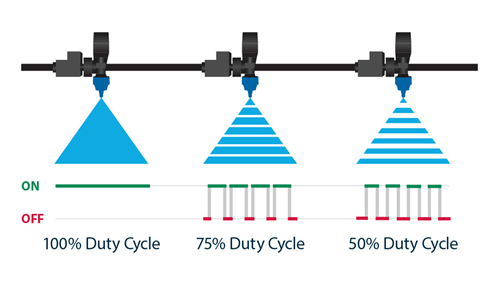
For example:
- 100% duty cycle – nozzle fully open – continuous spray (maximum flow).
- 75% duty cycle – nozzle open 75% of the time and closed 25%, slightly reduced flow.
- 50% duty cycle – nozzle open half the time, half the flow.
By adjusting the duty cycle instead of pressure, PWM allows applicators to change travel speed or application rate without significantly altering droplet size. Maintaining stable pressure helps preserve droplet consistency, which is essential for both coverage and drift management.
Why PWM Matters in the Field
Field conditions are rarely uniform. Slopes, turns, and speed variations can make it difficult for traditional spray systems to maintain consistent performance.
PWM helps overcome these challenges by maintaining stable spraying characteristics even as conditions change.
With PWM technology, applicators can:
- Maintain uniform droplet size regardless of travel speed
- Preserve consistent spray patterns during turns
- Reduce over-application and under-application across variable terrain
- Avoid pressure fluctuations that can alter droplet quality
The result is improved coverage, better target accuracy, and more efficient pesticide applications.
Not Every Spray Tip Is Built for PWM
While PWM offers powerful control over application rates, its performance depends heavily on the spray tip used in the system.
Because PWM systems rapidly pulse the spray flow, spray tips must be capable of forming a stable spray pattern almost instantly during each pulse cycle. Some conventional spray tips may struggle under these conditions, leading to issues such as:
- Inconsistent pattern formation during pulsing
- Droplet inconsistency
- Reduced coverage stability
For optimal PWM performance, spray tips should be able to:
- Form a spray pattern quickly
- Reach steady-state performance rapidly
- Deliver crisp on/off response during pulsing
- Maintain reliable performance under frequent cycling
Selecting the right spray tip ensures the system can deliver consistent droplet size, accurate rate control, and uniform coverage across varying speeds and terrain.
TeeJet® Premium PWM Spray Tip Selection: Where Precision Comes Together
PWM technology delivers exceptional rate control—but its full potential is realized when paired with spray tips designed to perform in pulsing systems.
TeeJet® Premium PWM spray tips are engineered to maintain droplet consistency, pattern uniformity, and stable hydraulic performance across a wide range of duty cycles.
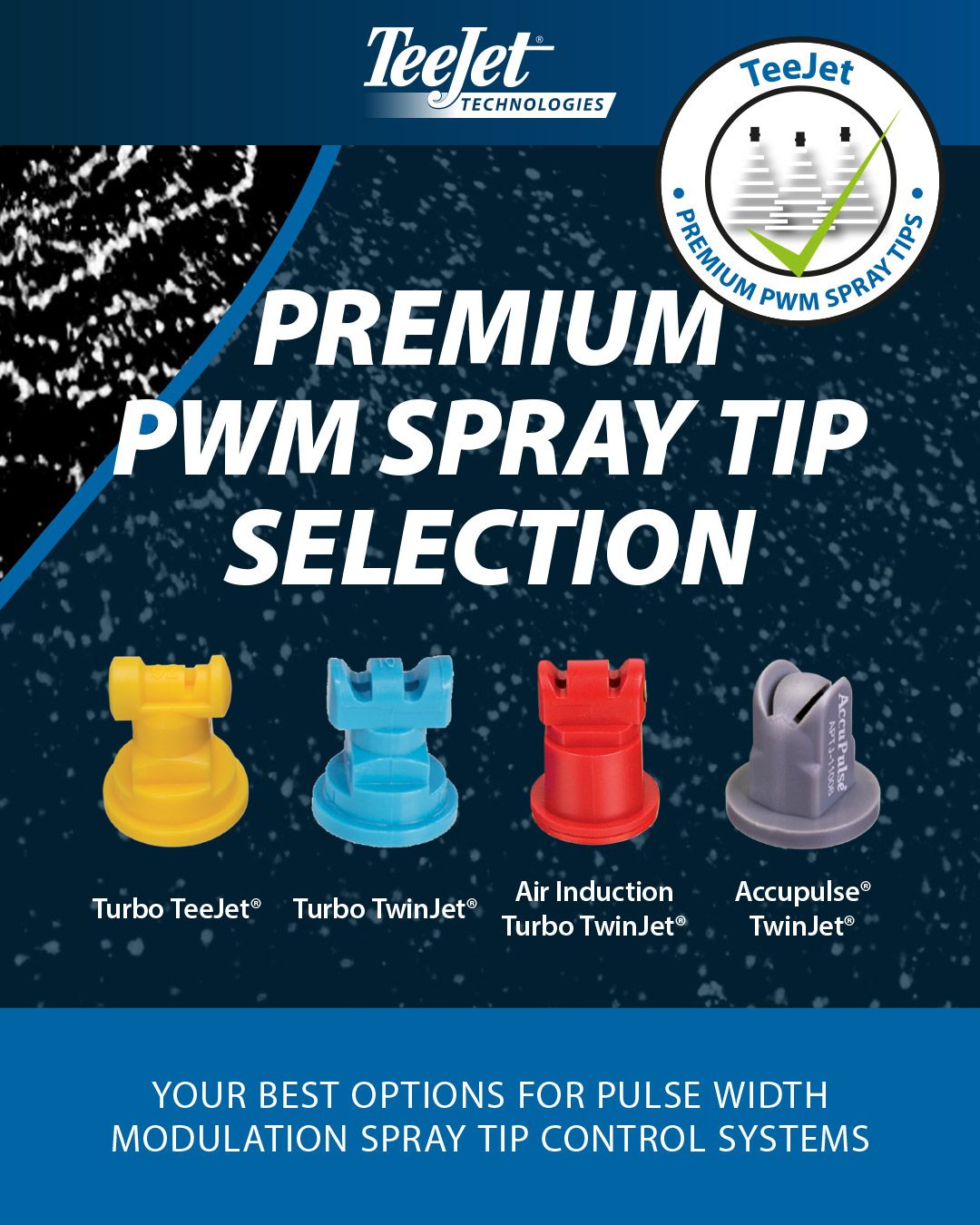
Premium PWM options include:
These spray tips have a design to deliver excellent coverage, droplet control, and drift management while operating with PWM systems.
Unlike conventional tips, TeeJet Premium PWM tips respond accurately to PWM pulsing, helping maintain the spray quality and field performance applicators depend on.
Choosing the Right Spray Tip for PWM Systems
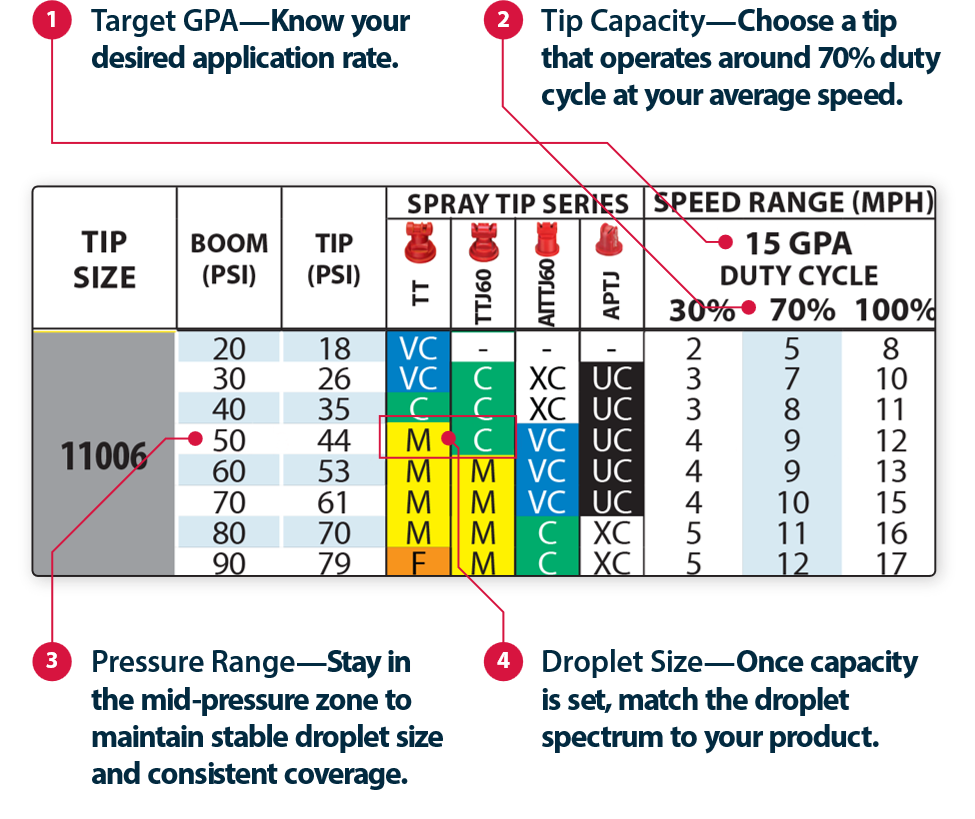
Getting the most out of your PWM setup starts with choosing the right tip. Consider these four key factors when making your choice:
- Target GPA
- Tip Capacity
- Pressure Range
- Droplet Size
Start by identifying the desired application rate for the product and crop.
Select a tip size that operates around 70% duty cycle at average field speed, providing flexibility for both slower and faster conditions.
Operate within the mid-pressure range to maintain stable droplet size and consistent spray patterns.
Match the droplet spectrum to the product being applied. For example, glufosinate applications typically require Medium to Coarse droplets for effective coverage and performance.
Smarter Spraying Starts with the Right Technology
As application technology continues to evolve, PWM is becoming an increasingly valuable tool for applicators seeking greater precision and control. When combined with properly selected spray tips, PWM systems help ensure consistent spray quality, improved efficiency, and better performance across real-world field conditions.
In modern crop protection, precision is everything—and PWM helps deliver it with every pass.